
How to Clean a Teak Deck on a Boat: The Definitive 2026 Guide

The hardest scrub you give your deck is often the quickest way to destroy it. Whilst it is tempting to reach for a stiff brush and a high-pressure hose, these aggressive methods tear away the soft wood grain and perish the caulking. If you are wondering how to clean a teak deck on a boat without causing permanent damage, you must first master the art of restraint. You likely want to avoid the grey, weathered look and the mould growth that plagues many Auckland vessels, yet the fear of an expensive restoration often prevents action.
We agree that your vessel should be the pride of the marina, boasting either a rich golden glow or a sophisticated, uniform silver-grey finish. This definitive 2026 guide promises to give you the knowledge of professional tools and eco-friendly chemicals required to maintain your deck like a specialist. We will preview the best techniques to remove grime, explain the impact of the latest EPA regulations on solvents, and provide a clear path to extending the lifespan of your timber. It is time to get your deck back to its best and ensure your asset remains in safe hands.
Key Takeaways
Learn the precise steps of how to clean a teak deck on a boat to remove stubborn grime whilst preserving the delicate soft grain and protective oils.
Discover why the "Soft Brush Rule" and a standard garden nozzle are your best defences against wood erosion and perishing caulking.
Understand the "Saltwater Secret" and how choosing modern breathable sealers over traditional oils can significantly extend your deck's lifespan.
Identify the critical "End of Life" signs, such as proud caulking and deep ridges, that signal when a simple wash is no longer enough.
Master the preparation phase by thoroughly wetting the timber to ensure cleaning agents don't penetrate too deeply into the wood fibres.
Table of Contents
Understanding Teak: Why Your Boat Deck Turns Grey
Teak is the gold standard for marine decking because of its unique biological makeup. High concentrations of tectoquinones, which are natural oils found within the timber, provide the legendary resistance to rot and pests that boat owners rely on. You can explore these essential teak wood properties to understand why this species remains the first choice for high-end vessels. However, even the finest timber isn't immune to the elements. When your deck begins to lose its golden hue, it is usually a result of surface lignin breaking down under intense sunlight.
This "silvering" process is a natural defence mechanism. The grey layer acts as a sacrificial barrier that protects the deeper wood fibres from further UV damage. It isn't a sign of rot. In fact, many experienced captains prefer this look. The danger arises when you cannot distinguish between a healthy silver patina and a harmful fungal infestation. If you notice dark, asymmetrical spotting or a slippery green film, you are dealing with mould and mildew. These organisms feed on moisture trapped in the grain. Learning how to clean a teak deck on a boat involves identifying these issues early before the fungi can compromise the wood's structural integrity.
Auckland’s environmental conditions are particularly harsh. Our high UV index, often significantly higher than European or North American climates, accelerates the drying of natural oils. This causes the wood to become brittle and prone to splitting if left untreated. Regular maintenance is the only way to counteract this rapid degradation.
The Anatomy of a Teak Plank
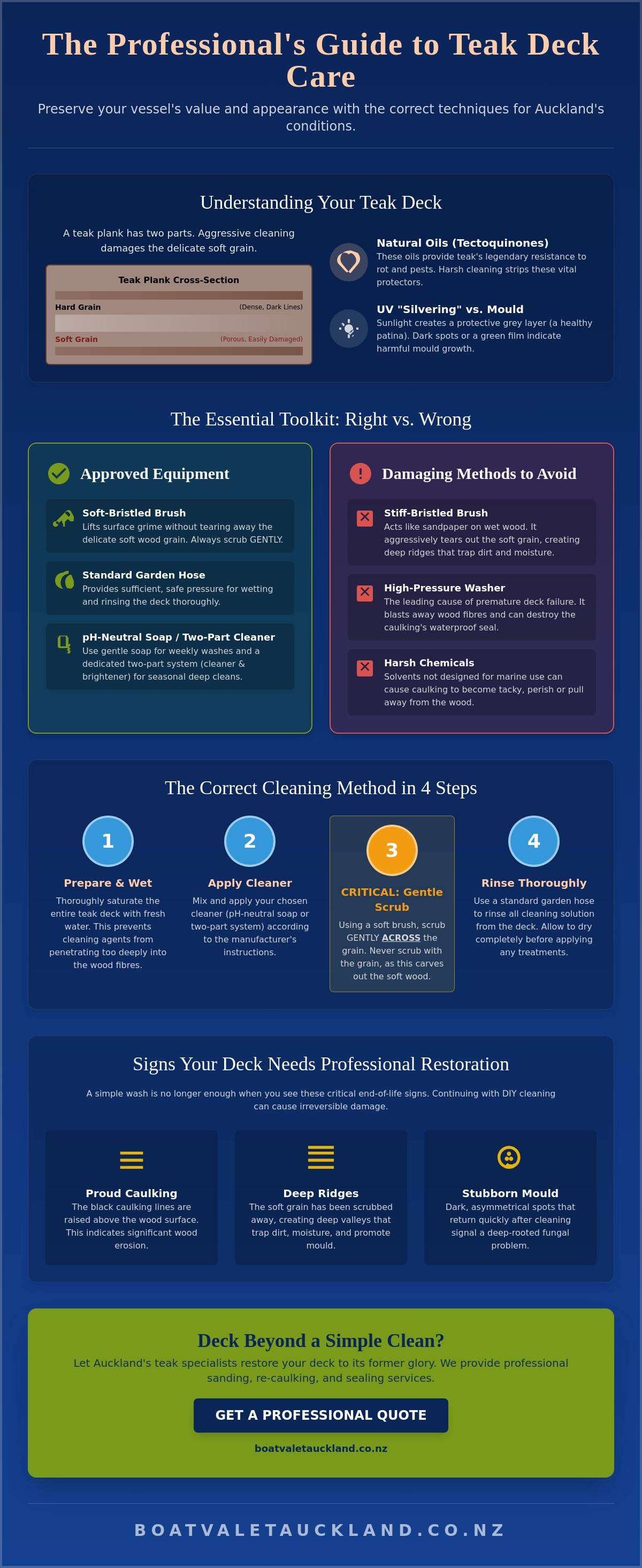
Every teak plank consists of hard and soft grain. The dark, dense lines are the hard grain; the lighter, more porous areas between them are the soft grain. If you use a stiff brush or a pressure washer, you will inadvertently "dig out" the soft grain. This creates deep ridges that trap dirt and moisture, making future cleaning much harder. You must also consider the caulking. These black expansion joints are designed to be flexible, but harsh chemicals can cause them to become tacky or pull away from the wood. Maintaining a flush surface between the timber and the caulking is vital for a watertight deck.
Auckland Environmental Factors
Vessels moored in the Waitematā Harbour face a unique set of challenges. The local salt air is highly corrosive, whilst urban soot from the city centre often settles on decks, turning them a dull, dirty grey rather than a clean silver. This pollution acts as an abrasive when walked upon, grinding into the wood. Despite these factors, a well-maintained silver deck remains a badge of honour amongst the Auckland yachting community. It signals a boat that is used and loved, provided the wood remains smooth and the grain stays tight. Knowing how to clean a teak deck on a boat in this specific environment requires a balance between removing city grime and preserving the timber's natural defences.
Essential Tools and Materials for Teak Cleaning
Successful maintenance starts with the right kit. If you want to know how to clean a teak deck on a boat properly, you must follow the "Soft Brush Rule". Stiff bristles act like sandpaper on wet wood. They tear out the soft grain, leaving behind an uneven, ridged surface that traps dirt. Instead, choose a soft-bristled brush or a dedicated deck scrub pad. These tools lift surface grime without compromising the timber's integrity.
Your water source is equally vital. A standard garden hose with a multi-spray nozzle provides sufficient pressure for rinsing. Avoid pressure washers at all costs. In New Zealand, these machines are the leading cause of premature deck failure. They blast away the wood fibres and destroy the bond between the plank and the caulking. Keep a couple of clean buckets handy to mix your solutions. This allows you to control the concentration of your cleaners and prevents wastage.
Safety shouldn't be an afterthought. When you use brighteners or two-part systems, wear chemical-resistant gloves and eye protection. These liquids are often acidic. They can cause skin irritation or damage your boat's gelcoat if splashed. If the task feels overwhelming or you lack the specific equipment, our team provides professional Teak Restoration services to handle the heavy lifting for you.
Choosing the Right Cleaner
pH-neutral marine soaps are best for regular, weekly washes. They remove salt and soot without stripping natural oils. For deeper seasonal cleans, you might require a two-part system. Part one is a cleaner that removes grey oxidation and dirt. Part two is a brightener that restores the golden colour. You can research various teak cleaning methods to see which chemical balance suits your specific deck condition. Avoid household bleach or high-alkaline detergents. These chemicals dry out the wood and can turn your expensive teak into a brittle, white mess.
The "Never Use" List
Certain items should never touch your deck. Wire brushes are too aggressive and will ruin the finish instantly. Sandpaper is a tool for restoration, not routine cleaning. Misusing it can take years of life off your planks. Finally, be cautious with traditional oils. Whilst they look good initially, many cheap oils trap heat under the Auckland sun. This can actually "cook" the wood and turn the deck black over time. Stick to modern, breathable sealers for the best results.
Step-by-Step: How to Clean Your Teak Deck Correctly
Preparation is the most overlooked step in marine maintenance. You must saturate the timber with fresh water before any cleaner touches the surface. Dry teak acts like a sponge; it will pull chemicals deep into the wood fibres where they become impossible to rinse out. By pre-wetting the deck, you ensure the cleaning agents stay on the surface where the dirt lives. This simple act prevents internal chemical rot and protects the longevity of your investment.
Organise your work into manageable sections. Attempting to scrub the entire cockpit at once is a mistake because the cleaner will dry before you can agitate it. Focus on areas of roughly one to two square metres. This methodical approach is the secret to how to clean a teak deck on a boat without leaving unsightly streaks or patches. Apply your solution evenly and let it dwell for the time recommended by the manufacturer, usually no more than a few minutes.
The Scrubbing Technique
Your brush movement is the difference between a beautiful finish and a ruined deck. Always scrub across the wood grain at a 90-degree angle. This technique lifts grime from the pores without scouring out the soft timber between the hard grain lines. If you encounter stubborn stains like fish blood or bird droppings, resist the urge to apply heavy pressure. Instead, reapply a small amount of cleaner and use a gentle, localised circular motion. As you work, you'll see a dark, muddy "slurry" develop. This is the suspended dirt and old oil. Wash this slurry away frequently to ensure you are actually removing the contaminants rather than just repositioning them.
Rinsing and Drying
Thorough rinsing is a two-part job. You must clear the wood grain and protect the surrounding surfaces. Whilst you work on the deck, keep the hull and stainless steel fittings wet. Slurry and cleaning chemicals can cause tea-staining on metal or leave stubborn streaks on your gelcoat if they dry. Once the wood is clear of all soap, stop. Avoid using squeegees or towels on the timber itself. Let the deck air-dry naturally to reveal the true result of your labour. A perfectly clean teak deck, once fully dry, should exhibit a consistent, velvet-like texture with no dark patches or salt crystals visible in the grain.
Preservation and Professional Maintenance Secrets
Preservation is where most boat owners lose the battle against the Auckland sun. Once you have mastered how to clean a teak deck on a boat, your focus must shift to maintaining that result. Aggressive scrubbing should be a rare event. Proactive preservation keeps the timber supple and prevents the grain from opening up. Regular marine detailing services NZ ensure that your deck receives professional-grade protection before damage becomes irreversible. This approach saves you from the high costs of premature timber replacement.
Why Saltwater is Your Friend
The best daily tonic for your deck is entirely free. A bucket of clean seawater is the most effective way to keep teak healthy between deep cleans. Salt is hygroscopic; it draws moisture from the air and holds it within the wood fibres. This prevents the planks from becoming brittle and shrinking under the intense Southern Hemisphere UV levels. Seawater also possesses mild antiseptic properties. This naturally inhibits the growth of mould and silver-grey algae whilst you are moored in the marina. For boaties returning to the dock after a day on the Hauraki Gulf, a simple splash of seawater across the deck is the ultimate finishing touch. It is a traditional maritime secret that remains the gold standard for timber care.
To Seal or Not to Seal?
Choosing between sealing and oiling is a critical decision for any vessel owner. Traditional teak oils often fail in the New Zealand summer. They are organic based; they eventually oxidise and turn black under high heat. This creates a sticky surface that attracts dirt and requires harsh chemicals to remove. Modern nano-sealers are far superior. They are breathable and create a molecular barrier that repels red wine, fish blood, and sunscreen. These sealers preserve the golden colour for months rather than weeks. If you prefer the silver look, you can still use clear sealers to provide protection without changing the aesthetic. This prevents the wood from drying out whilst allowing it to weather naturally.
In Auckland’s humid climate, a deep clean should occur every six months. This frequency prevents soot and salt from becoming baked into the grain. Waiting longer usually means you will need more aggressive agitation, which shortens the life of the timber. Professional maintenance is about restraint. We use specialised tools to remove contaminants whilst leaving the wood fibres intact. To keep your vessel in peak condition without the guesswork, contact us for a professional Teak Restoration consultation today.
When to Call the Professionals: Teak Restoration vs. Cleaning
There comes a point where even the most diligent maintenance routine cannot hide the passage of time. Whilst you now know how to clean a teak deck on a boat to remove surface grime, cleaning alone cannot fix structural wear. Restoration is a different beast entirely. It involves removing a microscopic layer of timber to reveal fresh wood and resetting the surface level of the deck. If your planks have developed deep ridges or the wood feels "hollow" underfoot, you have moved beyond the realm of simple washing. Professional intervention at this stage doesn't just improve aesthetics; it saves the deck from a total and incredibly expensive replacement.
A well-executed Teak Restoration is one of the best investments you can make for your vessel's resale value. Prospective buyers often view a grey, ridged deck as a massive future liability. In contrast, a deck that has been professionally levelled and sealed suggests a boat that has been meticulously maintained. This woodwork often goes hand-in-hand with our boat cut and polish Auckland services. When the gelcoat shines and the teak glows, your vessel truly becomes the pride of the marina.
Assessing Deck Damage
You can perform a few simple checks to see if your deck is at "end of life" for DIY care. Look for proud caulking; this is when the black lines sit higher than the wood planks. It indicates the timber has worn down significantly. Try the "knife test" by gently seeing if a thin blade can slide between the wood and the caulking. If it does, the seal is broken and water is rotting the bedding below. Also, watch for "popping plugs." If the round wooden caps covering your deck screws are falling out or appearing thin, the timber has reached a critical thickness. At this stage, deep mould has often settled into the grain and requires professional chemical treatment rather than more scrubbing.
The Boat Valet Auckland Approach
Steve Kellie leads our team with a "less is more" philosophy. We believe in preserving as much of your original teak as possible. Aggressive DIY sanding is the quickest way to ruin a deck, as modern teak is often only a few millimetres thick. One mistake can take five years off the life of your timber. Our mobile service comes directly to your berth in any Auckland marina, from Westhaven to Gulf Harbour. We provide a honest assessment of whether you need a deep clean or a full restoration. Contact Steve directly to organise a consultation and ensure your high-value asset remains in safe, expert hands. Let's get your vessel looking sharp for the season ahead.
Protect Your Vessel’s Value for the Season Ahead
Mastering how to clean a teak deck on a boat is about finding the balance between thoroughness and restraint. You now understand that the "Soft Brush Rule" and regular saltwater rinses are the foundation of a healthy deck. These simple habits prevent the deep ridges and mould growth that lead to costly timber replacement. By choosing modern nano-sealers over traditional oils, you protect your timber from the harsh Auckland UV whilst maintaining that sought-after golden or uniform silver-grey finish.
When routine maintenance isn't enough, call in a trusted local specialist. We have served the Auckland maritime community since 1998. Our mobile service operates at all major marinas, including Westhaven, the Viaduct, and Gulf Harbour. We provide expert restoration that preserves your vessel's value and structural integrity. It is our goal to ensure your timber looks sharp and performs perfectly for years to come.
Book a Professional Teak Assessment with Steve at Boat Valet Auckland to ensure your deck remains in peak condition. Your vessel is a high-value asset; keep it in safe hands and enjoy the pride of a perfectly maintained deck on the Hauraki Gulf.
Frequently Asked Questions
Can I use a pressure washer on my teak deck if I am careful?
No, you should never use a pressure washer on teak, regardless of how careful you are. The high-velocity water stream blasts away the soft grain of the timber and creates deep ridges that trap dirt. It also compromises the bond between the wood and the caulking, leading to leaks. If you want to know how to clean a teak deck on a boat safely, stick to a standard hose and a soft brush for routine maintenance.
Why does my teak deck turn black instead of grey?
Your deck turns black because of a build-up of mould, mildew, or oxidised teak oil. Whilst healthy teak weathers to a uniform silver-grey, black patches indicate trapped moisture or organic matter feeding on cheap, traditional oils. This is particularly common in Auckland's humid climate. A deep clean with a pH-neutral solution is required to remove these contaminants without damaging the wood fibres or the surrounding gelcoat.
Is dishwashing liquid safe for cleaning boat teak?
Dishwashing liquid is not recommended for regular use on marine timber. These detergents are designed to strip grease, which means they also remove the natural protective oils, known as tectoquinones, from the teak. Over time, this makes the wood brittle and prone to cracking. Use a dedicated marine soap that is pH-neutral to clean your deck effectively without drying out the timber or perishing the caulking.
How do I remove red wine or grease stains from teak?
Act quickly by blotting the spill with a clean cloth to absorb as much liquid as possible. Avoid rubbing the stain deeper into the grain. For grease or wine, use a dedicated teak spot cleaner or a paste made from a pH-neutral detergent and fresh water. If the stain persists, a very light sanding of the specific area may be necessary, followed by an application of a breathable nano-sealer to prevent future accidents.
Should I scrub with the grain or against the grain of the wood?
You must always scrub across the grain at a 90-degree angle. Scrubbing with the grain acts like a saw, digging out the soft wood and leaving the hard grain standing in ridges. This is a fundamental rule for anyone learning how to clean a teak deck on a boat. Cross-grain agitation lifts dirt from the pores whilst keeping the surface flush and smooth, ensuring your deck lasts for many more seasons.
How often should a teak deck be professionally sanded?
Professional sanding should be a rare event, ideally only once every five to ten years depending on the timber's thickness. Every sanding removes a layer of wood, so it should only be done when the grain is deeply ridged or the caulking has become proud. Frequent light cleaning and the use of modern sealers are far better for the deck's longevity than aggressive, repeated restoration.
What is the best way to stop mould growing on my teak?
The best way to prevent mould is to ensure the deck dries quickly after rain or washing. Avoid leaving wet covers over the timber for long periods as this creates a greenhouse effect that encourages fungal growth. A regular splash of clean seawater is an excellent natural antiseptic that inhibits mould. For long-term protection, apply a modern breathable sealer that prevents moisture from soaking into the wood fibres.
Can I use bleach to brighten my teak deck?
Never use household bleach to brighten your deck. It is highly alkaline and destroys the cellulose fibres of the wood, making it appear "fuzzy" and white rather than golden. Bleach also attacks the chemical bond of the caulking, causing it to fail and pull away from the planks. Use a professional two-part brightener that is specifically formulated for marine use to achieve a safe, even colour without structural damage.
Comments