Marine Detailing in the Viaduct: The 2026 Guide to Luxury Vessel Care

Your vessel's greatest enemy isn't the open ocean; it's the relentless combination of city soot and salt spray that settles on your gelcoat every day in the heart of Auckland. Keeping a luxury boat berthed here requires more than a casual rinse. You already know that the harsh marine environment and urban pollutants can dull a world-class finish in weeks. Finding a reliable partner for marine detailing viaduct services means looking for someone who understands the technical precision needed for high-value assets and respects the strict $10 million insurance requirements of the harbour.
It's frustrating when you can't find mobile contractors who show up or appreciate the standard of care your investment deserves. This guide reveals the professional protocols required to achieve a showroom shine that actually lasts against UV and salt. You'll discover how to protect your vessel's resale value through expert teak restoration, stainless steel polishing, and precision boat cut and polish techniques. We also preview the essential maintenance routines, from engine room cleaning to interior valets, that keep the Viaduct's most prestigious vessels in peak condition throughout 2026.
Key Takeaways
Learn why a standard wash fails to address deep-seated salt damage and how professional restoration defines the standard for luxury vessels.
Understand the technical process of a professional boat cut and polish that removes microscopic oxidation to restore your hull’s original lustre.
Identify how central Auckland’s city soot and diesel particulates dictate a more frequent schedule for specialised marine detailing viaduct services.
Build a strategic maintenance plan to protect your vessel’s long-term resale value through a combination of quarterly refreshes and annual protection.
Leverage over 25 years of local Auckland maritime experience with mobile grooming solutions delivered directly to your berth.
Table of Contents
What is Marine Detailing? Defining the Standard for Viaduct Vessels
The Anatomy of a Professional Cut and Polish: Beyond a Simple Wash
Urban Marina Factors: Why Viaduct Berths Demand Specialist Care
Establishing a Maintenance Schedule: Preserving Your Vessel’s Resale Value
Expert Marine Grooming at Viaduct Harbour: The Boat Valet Auckland Difference
What is Marine Detailing? Defining the Standard for Viaduct Vessels
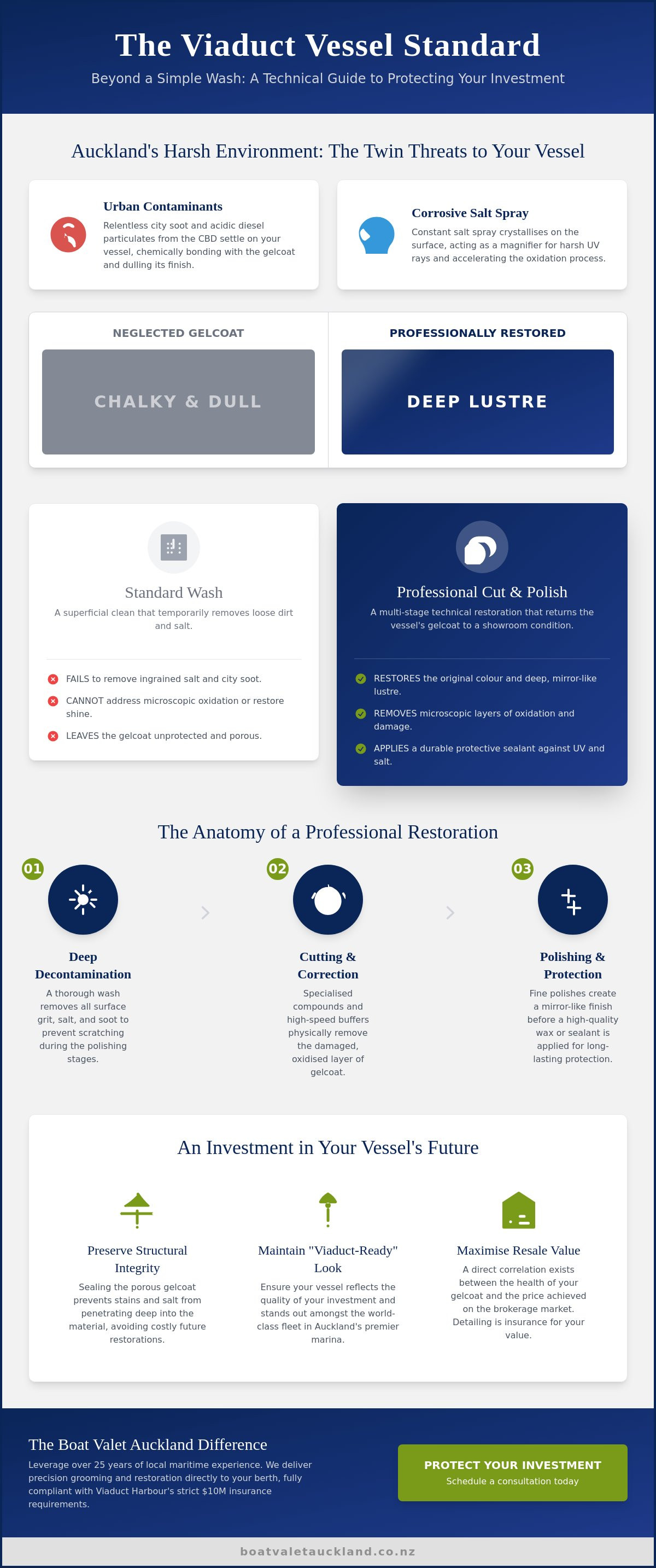
Marine detailing isn't just a bucket and sponge job. It's a technical restoration process designed to return a vessel to its peak aesthetic and structural condition. Whilst many owners mistake a quick rinse for maintenance, true marine detailing viaduct standards require a much deeper approach. You're dealing with a harsh environment where salt spray meets urban pollutants from the Auckland CBD. A standard wash clears surface dust. It won't touch the microscopic oxidation or the acidic soot eating into your finish.
Maintaining a "Viaduct-ready" look is about more than just vanity. This marina is Auckland's premier social hub; your vessel is on display to thousands of people every day. Professional detailing ensures every inch of the boat reflects the quality of your investment. It covers everything from the waterline to the flybridge. It's the difference between a dull, chalky hull and a deep, mirror-like reflection that stands out amongst the world-class fleet berthed here. Don't settle for basic grooming when your asset deserves a specialist touch.
The Core Components of a Professional Detail
A professional detail starts with structural cleaning. This involves removing salt and grime from every crevice whilst ensuring that delicate fittings remain undamaged. Surface restoration follows, focusing specifically on the gelcoated surface. When gelcoat ages, it becomes porous and develops a "chalky" appearance. Professionals use specialised compounds to level this layer and bring back the shine. Finally, we apply protective coatings. Using high-quality waxes or sealants helps to organise a robust barrier against UV rays and airborne contaminants. This multi-stage process creates a finish that looks better and lasts longer.
Why Detailing is an Investment, Not an Expense
Think of detailing as insurance for your vessel's resale value. There's a direct correlation between the health of your gelcoat and the price you'll get on the brokerage market. Regular marine detailing viaduct maintenance prevents the permanent "yellowing" often seen on neglected boats in high-traffic marinas. By sealing porous surfaces early, you stop stains from penetrating deep into the material. This proactive care reduces long-term maintenance costs. It's much cheaper to maintain a polished surface than it is to pay for a full restoration once the damage becomes structural. Protect your asset by choosing a partner who values precision as much as you do.
The Anatomy of a Professional Cut and Polish: Beyond a Simple Wash
A standard wash cleans the surface. A cut and polish restores the vessel's soul. Most owners in the marina don't realise that gelcoat is actually porous. Over time, the relentless New Zealand sun and salt spray create a chalky, white layer known as oxidation. This isn't something you can simply scrub away. True marine detailing viaduct standards require a mechanical process to physically remove those microscopic layers of dead material. We use high-speed rotary buffers and specialised marine compounds to level the surface and reveal the vibrant colour trapped underneath.
The "cut" stage is where the transformation happens. It's the heavy lifting of restoration. By using varying grades of abrasive compounds, we strip back the damage without compromising the hull's integrity. This process restores depth and clarity to the finish. It's the only way to achieve that signature "wet look" that defines the luxury yachts berthed in central Auckland. Without this step, any wax you apply is just sitting on top of a failing surface. It's a waste of time and money.
The Multi-Stage Restoration Process
Stage 1: Deep decontamination wash. We remove every trace of surface grit, salt, and city soot. This ensures we aren't grinding dirt into the gelcoat during the buffer stages.
Stage 2: Cutting compounds. Depending on the condition of your vessel, we use heavy or light compounds to strip away oxidation and light scratches.
Stage 3: Fine polishing. This final mechanical step removes any remaining swirl marks and enhances the gloss to a mirror-like finish.
Selecting the Right Protection for Auckland Waters
Once the surface is restored, it needs a shield. Auckland's environment is notoriously harsh on maritime finishes. We often choose between traditional marine-grade Carnauba waxes for a deep, warm glow or synthetic polymer sealants for maximum longevity. Modern polishes now include advanced UV-inhibitors specifically designed to combat the high UV index found in New Zealand. Investing in a professional boat cut and polish Auckland service ensures your vessel remains protected for the long term. Well-maintained vessels consistently hold value better when it comes time to upgrade. If you aren't sure which protection suits your usage, a professional Exterior Wash and Wax can provide the immediate barrier your hull needs.
Urban Marina Factors: Why Viaduct Berths Demand Specialist Care
Berthing your vessel in the Viaduct places it at the intersection of luxury and industry. Whilst the location is unbeatable for socialising, it presents a unique set of environmental challenges that don't exist in quieter bays. The proximity to Auckland's CBD means your boat is constantly bombarded by diesel particulate matter from heavy traffic and ferry movements. This urban fallout settles on every horizontal surface. When mixed with the humid, salt-heavy air of the Waitematā, it creates a sticky, acidic film that standard soaps often struggle to shift. Professional marine detailing viaduct services must account for this specific atmospheric cocktail to prevent long-term damage.
The chemical reaction between salt spray and city soot is particularly aggressive on high-value finishes. Salt attracts moisture, whilst diesel soot contains trace amounts of sulphur and carbon. Together, they create a corrosive paste that can etch into your gelcoat if left for more than a few weeks. This is why central Auckland’s air quality requires a more aggressive decontamination schedule than vessels kept in outlying marinas. High-traffic areas also see a significant increase in "fallout" on decks, ranging from construction dust to general city grime. Regular surface maintenance isn't just about looks; it's about stopping these pollutants from bonding permanently to your vessel.
Combating the "City Grime" Effect
You've likely noticed those stubborn black streaks running down the hull after a light rain. This is urban runoff, where soot and pollutants from the flybridge are washed down the sides of the boat. If you don't use the right products, these streaks can "ghost" into the gelcoat, leaving permanent marks. We use pH-neutral cleaners for frequent washes to ensure we remove the grime without stripping away your protective wax. Regular detailing prevents this soot from etching into the surface, keeping your boat looking pristine amongst the world-class fleet in the harbour. If the grime has already started to settle, an Exterior Wash and Wax is the best way to reset the surface.
Stainless Steel and Glass: The Urban Challenge
Stainless steel railings are especially vulnerable in the Viaduct. The combination of salt and city dust leads to "tea-staining", those unsightly brown rust spots that dull your hardware. Our Stainless Steel Polishing service removes these deposits and applies a protective barrier to keep the metal bright. Glass restoration is equally vital. Mineral deposits from city rain and sea spray can quickly obscure your vision. We use specialised Window Polishing techniques to remove these stubborn spots, ensuring you have clear sightlines and a brilliant shine on all exterior hardware. Maintaining these details is what separates a well-kept yacht from a neglected one.
Establishing a Maintenance Schedule: Preserving Your Vessel’s Resale Value
Owning a luxury vessel in Auckland is a commitment to preservation. You can't treat marine detailing viaduct as a one-off event. The most successful owners use a structured schedule to stay ahead of the environmental damage we've discussed. Your frequency depends on how often you leave the berth. If you're cruising the Hauraki Gulf every weekend, your protective layers wear down faster. A vessel that sits idle in the marina faces a different threat: the slow accumulation of acidic city soot. Balancing professional care with your own weekly wash-downs is the only way to maintain a world-class finish.
The "Quarterly Refresh" is your most effective tool. This involves a deep exterior wash followed by a high-quality wax application. It replenishes the UV-inhibitors that the New Zealand sun destroys. Contrast this with the "Annual Restoration", which is a full mechanical cut and polish. If you skip the quarterly maintenance, your annual job becomes much harder and more expensive. Spotting early signs of gelcoat failure is simple. Run your dry palm across the hull. If a white, chalky residue transfers to your skin, the oxidation has already begun. Act quickly. You need to intervene before the surface becomes too porous to save.
The Ideal Detailing Calendar for Auckland
Pre-summer preparation: This is the time for a heavy Boat Cut and Polish. You want maximum protection before the peak UV months of December and January.
Mid-season maintenance: Focus on wax top-ups and Stainless Steel Polishing. This prevents tea-staining from taking hold during high-use periods.
Winter preservation: Don't ignore the boat just because it's cold. A final protective layer in May helps the hull withstand the damp, soot-heavy winter air.
The Role of Marine Detailing Services NZ in Asset Management
Consistent detailing is a form of asset management. At the point of sale, a documented history of professional care is invaluable. Buyers and brokers look for "pride of ownership" amongst the listings. If you can show a log of regular Pre-Sale Grooming and maintenance, it increases confidence during a marine survey. It proves that the gelcoat hasn't been allowed to degrade over time. Proactive care is always more cost-effective than reactive repairs. Sealing your surfaces today prevents the need for an expensive respray tomorrow. To get your vessel on a professional schedule, book a precision grooming session today and protect your investment.
Expert Marine Grooming at Viaduct Harbour: The Boat Valet Auckland Difference
When you choose Boat Valet Auckland, you aren't hiring a faceless corporation. You're partnering with Steve Kellie, a local specialist with over 25 years of experience in the Auckland maritime industry. I understand that your vessel is a significant investment. Providing marine detailing viaduct services requires a level of accountability that only an owner-operator can offer. We don't just tick boxes; we treat every hull as if it were our own. My long-standing tenure in the industry means I've seen every type of surface degradation the Waitematā can throw at a boat.
Our mobile service is designed for the convenience of Viaduct berth holders. There's no need to coordinate vessel movements or deal with the logistics of boatyard stays. We come directly to your berth. We bring everything needed to perform a high-end Boat Cut and Polish or a comprehensive Interior Valet. We use only premium, marine-grade compounds specifically selected to withstand the brutal New Zealand UV index. These aren't off-the-shelf products; they are professional-strength sealants that organise a genuine barrier against the elements.
A Personalised Approach to Vessel Care
Every boat has its own history and material nuances. Whether you have a modern composite hull or a classic timber build requiring Teak Restoration, we adapt our techniques to suit. Direct communication is the hallmark of our service. You'll speak with me directly to discuss your goals, whether that's a quick Exterior Wash and Wax before a weekend away or a full Pre-Sale Grooming. My deep knowledge of Viaduct Harbour's specific logistics, including contractor registration and insurance requirements, ensures a seamless experience. We get the job done without the administrative headaches.
Ready to Restore Your Vessel’s Shine?
Restoring your vessel's lustre starts with a simple conversation. You can book a consultation at your Viaduct berth or private jetty today. During your first professional marine detailing viaduct session, we'll assess the condition of your gelcoat, stainless steel, and teak. We provide a clear, customised plan to bring your boat back to showroom standards. Join the growing community of Auckland boat owners who trust Boat Valet to maintain their world-class finish. Let's get your vessel back to its best. Contact Steve Kellie to organise your next grooming session and see the difference that expert care makes.
Secure Your Vessel's Future Shine
Your boat is a major asset that deserves more than just a surface clean. We've explored how the unique combination of city soot and salt spray in central Auckland requires a technical approach to preservation. By following a structured maintenance schedule and prioritising a professional cut and polish, you protect your gelcoat from the harsh New Zealand sun whilst significantly boosting your vessel's resale value. It's about being proactive rather than reactive.
Boat Valet Auckland has provided specialist marine detailing viaduct services since 1998. With over 25 years of local expertise, Steve Kellie offers a fully mobile service that brings professional standards directly to your berth. You get the personal accountability of an owner-operator who understands the specific needs of the Viaduct's world-class fleet. Don't let urban pollutants dull your finish. Book your professional marine detailing at the Viaduct with Steve today and enjoy the confidence of a showroom shine that lasts. We look forward to seeing you on the water.
Frequently Asked Questions
How often should I have my boat detailed if it is berthed in the Viaduct?
You should schedule a professional refresh every three to four months to combat the specific urban pollutants found in central Auckland. Vessels berthed here face constant exposure to ferry exhaust and CBD road dust. A quarterly schedule ensures these contaminants don't etch into your finish, whilst a full restoration should be performed once a year to maintain deep clarity and protection.
What is the difference between boat grooming and marine detailing?
Boat grooming typically refers to regular maintenance like washing and basic valeting to keep the vessel tidy. In contrast, marine detailing viaduct standards involve mechanical restoration and long-term protection. This includes removing oxidation layers, machine polishing to a mirror finish, and applying high-grade sealants that a standard wash cannot provide. It is a technical process rather than a simple cleaning routine.
Can you remove heavy oxidation from an older fibreglass boat?
We can restore most oxidised surfaces by mechanically stripping away the dead, chalky layers of gelcoat. As long as there is sufficient material thickness left to work with, a multi-stage cutting process can reveal the original colour underneath. We assess the surface condition first to ensure the restoration is safe and effective for your specific hull before we begin the machine work.
Do I need to be present whilst the detailing service is being performed?
You don't need to stay with your vessel during the service as we operate a fully mobile and independent model. We coordinate with the marina office or use your provided access codes to board and perform the work. Many owners prefer to receive a digital update once the job is finished, allowing you to return to a showroom-ready boat at your own convenience.
Is professional marine detailing safe for all types of gelcoat and paint?
Professional detailing is safe when the correct compounds and pad speeds are matched to your vessel's specific finish. Modern two-pack paints require a different level of aggression than traditional gelcoat. We adjust our mechanical pressure and chemical choices to ensure we enhance the gloss without compromising the integrity of the protective outer layer or causing any surface burning.
How long does a full cut and polish typically take for a 40ft yacht?
A comprehensive cut and polish for a 40ft yacht generally requires two to three full days of labour. This timeframe allows for a deep decontamination wash, multiple stages of machine buffing, and the final application of a protective sealant. If the vessel has heavy oxidation or requires extensive stainless steel polishing, the process may take longer to ensure every detail meets our professional standards.
Will detailing help prevent the "tea-staining" I see on my stainless steel?
Regular marine detailing viaduct visits include specialised stainless steel polishing that removes the surface tea-staining caused by salt and city soot. Once we've cleared the oxidation, we apply a dedicated metal sealant. This barrier prevents moisture and salt from reaching the steel, significantly reducing the frequency of those unsightly brown rust spots on your railings and cleats.
What should I do to maintain the finish between professional detailing visits?
Use a high-quality, pH-neutral boat soap for your weekly wash-downs to avoid stripping away the protective wax or sealant we've applied. Avoid using harsh household detergents or abrasive brushes that can create swirl marks in the polished surface. A thorough fresh-water rinse after every outing is the best way to stop salt crystals from bonding to the gelcoat and dulling the shine.
Comments