
What is a Boat Cut and Polish? The Ultimate Guide to Gelcoat Restoration

Have you ever run your hand along your hull only to find your palm coated in a chalky white residue? This ghostly powder is more than just a mess. It's a clear sign that New Zealand’s brutal UV rays are actively destroying your gelcoat. Many owners ask what is a boat cut and polish and whether it’s simply a fancy name for a standard wax. In reality, it’s a precise, mechanical restoration that acts like surgery for your boat’s surface, stripping away damage rather than just covering it up.
It’s natural to feel a loss of pride when your vessel looks dull and dated amongst the sleek boats at the marina. You might even worry that the oxidation has gone too far to be fixed. We understand that your boat is a high-value asset that requires expert handling to maintain its worth. This guide promises to show you how a professional multi-stage cut and polish restores a deep colour and mirror shine. We will preview the technical process that stops further damage in its tracks, protects your resale value, and brings back the factory-fresh finish you love.
Key Takeaways
Learn exactly what is a boat cut and polish and how this multi-stage mechanical process strips away oxidation to reveal the deep colour beneath.
Discover how the "chalk test" identifies early-stage surface failure before New Zealand's intense UV rays cause permanent gelcoat damage.
Understand the technical risks of DIY restoration, including the danger of burning through gelcoat edges with high-speed rotary buffers.
Master the post-restoration maintenance steps needed to lock in a mirror finish using specialised carnauba waxes or ceramic coatings.
Implement a pH-neutral wash-down routine to preserve your vessel's shine and protect its long-term resale value in the local market.
Table of Contents
Defining the Process: What is a Boat Cut and Polish?
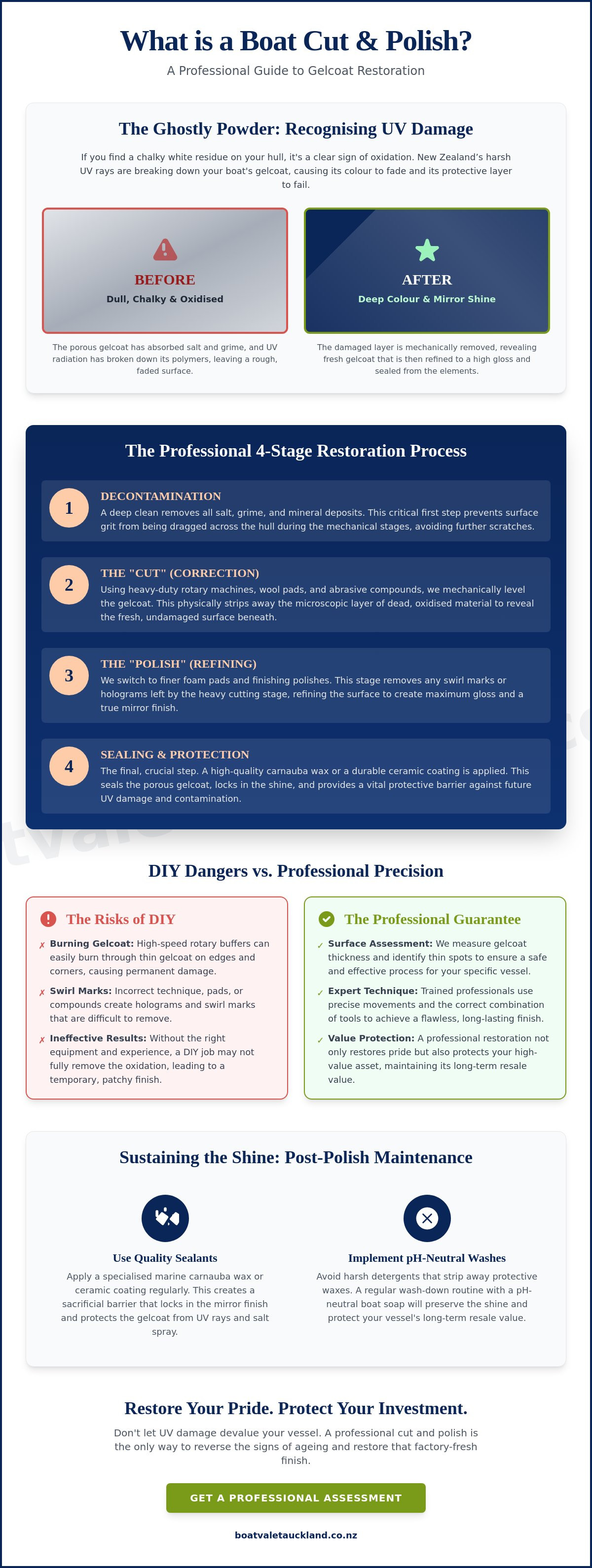
A boat cut and polish isn't a simple cleaning job; it's a multi-stage mechanical restoration of your vessel's exterior. Many owners ask what is a boat cut and polish when they notice their hull losing its lustre. Essentially, the "cut" stage uses specific abrasive compounds and heavy-duty rotary machines to physically level the surface. We remove a microscopic layer of oxidised gelcoat to reveal the fresh, undamaged material hidden underneath. Once the surface is level, the "polish" stage refines that material to achieve a mirror-like, high-gloss finish. The process typically involves:
Decontamination: Removing salt, mineral deposits, and surface grime.
Cutting: Levelling the gelcoat with abrasive compounds to strip away oxidation.
Polishing: Refining the surface with finer pads to create maximum gloss.
Sealing: Applying a protective layer to lock in the shine and block UV rays.
For vessels moored in Auckland, this process is an absolute necessity. The combination of high salt spray and extreme UV levels in the Hauraki Gulf creates a uniquely hostile environment for any marine surface. Regular maintenance ensures your boat doesn't just look better, but stays protected against the elements.
Gelcoat vs. Marine Paint: Why Surface Type Matters
Understanding your surface type is the first step in any successful restoration. What is Gelcoat? Technically, it's a porous resin used as the protective outer layer of a fibreglass hull. Unlike automotive paint or modern marine paints, gelcoat is significantly thicker and lacks a separate clear coat. This porous nature makes it highly susceptible to absorbing salt, grime, and environmental contaminants. Because it's so dense, it requires a much more aggressive "cutting" approach than painted finishes to reach healthy material. Professional groomers always assess the gelcoat thickness and condition before starting the work. We identify thin spots on strakes and corners to ensure the mechanical process remains safe and effective for your specific vessel.
The Role of UV Radiation in Auckland’s Marine Environment
New Zealand has some of the highest UV levels in the world, and our marine environment is particularly unforgiving. These harsh rays penetrate the gelcoat and break down the chemical polymers that provide structural integrity and shine. Understanding what is a boat cut and polish involves recognising that you are physically removing this sun damage. This leads to a chemical transition where the smooth, reflective surface turns into a "chalky" oxidised state. This is why you see white residue on your hands after touching the hull. You can't simply wash this away with a bucket and brush. No amount of soap will reverse the structural breakdown of these polymers. A professional cut and polish is the only way to physically strip back that dead, sun-damaged layer and expose the vibrant, protected colour underneath.
The Two-Stage Mechanical Process: Cutting vs. Polishing
A successful restoration follows a strict sequence of operations. Understanding what is a boat cut and polish requires looking past the final shine to the mechanical work involved. We don't just apply a product; we follow a four-step system designed for maximum longevity and surface health.
Step 1: Decontamination. We perform a deep clean to remove salt, minerals, and surface grime. This prevents grit from being dragged across the hull during the machine stages.
Step 2: The Heavy Cut. Using wool pads and coarse abrasive compounds, we level the oxidised surface.
Step 3: Refining. We switch to foam pads and fine polishes to remove "swirl marks" or holograms.
Step 4: Surface Sealing. We apply a high-quality sealant or wax to lock in the finish and provide essential UV protection.
This structured gelcoat restoration process is what separates a professional finish from a temporary fix. It ensures the results last through the harsh conditions of a New Zealand summer.
Stage One: The "Cut" (Abrasive Restoration)
The "cut" is the most transformative part of the job. It involves the mechanical action of levelling the gelcoat surface to remove pits, scratches, and heavy oxidation. Pad selection is critical here. We often use wool pads for their aggressive cutting power on heavily weathered hulls, whilst microfibre pads might be used for lighter damage. Whilst the machine is running, we manage heat buildup carefully. If the gelcoat gets too hot, it can "burn" or smear, leading to permanent damage. This is why a professional boat cut and polish service is often safer than a DIY attempt; it requires a steady hand and an eye for surface temperature.
Stage Two: The "Polish" (Refining and Clarity)
Once the oxidation is gone, the hull often looks "cloudy" from the heavy abrasives. Stage two involves moving from heavy compounds to fine finishing polishes. This step is about depth of colour and clarity. The fine abrasives in the polish act to close the "pores" of the gelcoat. When these pores are open, dirt and salt find a foothold, leading to rapid re-oxidation. By refining the surface to a perfectly smooth state, we achieve that famous "wet look" that characterises a professionally groomed vessel. It makes the hull easier to clean in the future, as water and salt simply bead off the surface. If you are still wondering what is a boat cut and polish, think of this stage as the final refinement that turns a dull surface into a mirror.
Identifying the Signs: When Does Your Vessel Need Restoration?
Your vessel often provides clear physical warnings before the gelcoat reaches a state of total failure. Recognising these signs early allows you to intervene with a targeted restoration rather than a costly repair. If you are still questioning what is a boat cut and polish meant to solve, start by inspecting the hull for specific environmental damage. Auckland’s intense marine conditions accelerate these issues, making regular inspections vital for any owner in the Hauraki Gulf.
The Chalk Test: Rub your hand across the dry hull. If your palm is coated in a fine white powder, the gelcoat polymers have oxidised.
Patchy Colour: Dark blue or black hulls often develop cloudy, milky patches where the sun has hit most directly.
Stubborn Waterline Stains: Yellow or brown staining that persists after a heavy wash indicates deep-seated mineral contamination.
Spider Webbing: Under direct Auckland sunlight, look for fine micro-scratches or "holograms" that dull the overall reflection.
These symptoms are more than just aesthetic flaws. They represent a breakdown in the material's ability to shed water and resist salt. Experts in professional gelcoat restoration suggest that ignoring these early signs leads to deeper pitting that a standard polish cannot fix.
Heavy Oxidation vs. Surface Dulling
It’s important to distinguish between simple surface dulling and heavy oxidation. Surface dulling usually requires a light refining polish to bring back the "wet look." However, heavy oxidation feels rough to the touch and looks completely flat. On white hulls, this often manifests as a distinct yellowing. This is the point where a heavy-duty mechanical cut is required. We must be careful, however. There is a point of no return where the gelcoat becomes too thin for further cutting. If you can see the dark shadow of the fibreglass weave beneath the surface, the protective layer is almost gone. At this stage, what is a boat cut and polish becomes a question of preservation rather than just restoration.
The Financial Impact of Neglected Hulls
Maintaining a smooth hull is a financial decision as much as a prideful one. A dull, oxidised hull is microscopically rough, which increases drag as you move through the water. This leads to higher fuel consumption whilst cruising, as your engine works harder to maintain speed. In the New Zealand resale market, appearance is everything. A vessel with a mirror-finish hull can command a significantly higher price than an identical boat with a faded exterior. Investing in preventative polishing is always more cost-effective than the alternative. Once the gelcoat fails completely, you face the massive expense of a full re-gelcoat or a professional repaint. Keeping the surface sealed and polished prevents that outcome entirely.
The Risks of DIY: Why Professional Marine Detailing is Safer
DIY restoration projects often look appealing on paper until you are standing on a slippery dock with a high-speed rotary buffer. Many owners ask what is a boat cut and polish and assume they can replicate professional results with a weekend hire tool. This is a risky assumption. High-speed buffers generate immense friction and heat. In the hands of a novice, these tools can "burn" through the gelcoat in seconds. This damage is often permanent and requires expensive repairs that far exceed the cost of professional grooming.
Common mistakes include staying too long on a single spot or applying inconsistent pressure on corners and strakes. Because gelcoat is naturally thinner on these sharp edges, it is remarkably easy to polish right through to the dark fibreglass beneath. Additionally, many owners try to save money by using automotive compounds. These are designed for thin, soft car paint and are completely ineffective against the hard, porous surface of marine gelcoat. You end up wasting time and money on products that cannot handle the job.
Specialised Equipment and Marine Compounds
Professional groomers use a specific combination of dual-action and rotary polishers. Rotary machines provide the torque needed for heavy-duty restoration, whilst dual-action polishers are safer for the final refining stages. Our professional-grade marine compounds contain no "fillers." Many cheaper retail products use heavy oils to temporarily hide scratches. These oils eventually wash off, revealing the original dullness after only a few weeks. We use high-end abrasives that physically level the surface for a permanent fix. Managing the logistics of a large vessel also requires experience. Polishing a boat on a trailer is one thing; doing it safely whilst the vessel is in the water requires specialised scaffolding and a steady hand.
The Advantage of Mobile Grooming in Auckland
Living in Auckland means dealing with unpredictable winds and intense humidity. These factors change how compounds dry and react on the hull. Steve Kellie and the team understand these local nuances and adjust their technique accordingly. We provide a mobile service that brings professional expertise directly to your local marina. This saves you the hassle of moving your vessel or trying to manage a complex restoration yourself. We follow strict safety protocols for working on docks and over water, ensuring no contaminants enter the harbour. If you want to avoid the stress and potential damage of a DIY disaster, book a professional boat cut and polish and let the experts handle the hard work.
Sustaining the Shine: Post-Polish Protection and Maintenance
Completing a restoration is a significant investment in your vessel's future. However, understanding what is a boat cut and polish includes knowing that the process leaves the gelcoat "naked." The mechanical action of cutting removes the old, protective oxidation but leaves the fresh material beneath vulnerable. Without an immediate protective layer, the Hauraki Gulf’s intense UV rays will begin damaging the new surface within weeks. We always follow a restoration with either a high-grade carnauba wax or a ceramic coating to seal those pores and lock in the clarity.
Maintaining that mirror finish requires a disciplined wash-down routine. You must use pH-neutral marine soaps for every clean. Standard household detergents are far too aggressive; they are designed to strip grease and will dissolve your wax layer in a single wash. We also recommend protecting your stainless steel and windows during the same session. A restored hull looks its best when the railings are free of tea-staining and the glass is crystal clear. Knowing what is a boat cut and polish helps you realise that protection is the final, vital step of the restoration story.
Waxing vs. Ceramic Coatings: Which is Right for You?
Carnauba wax offers a traditional, deep glow that many owners prefer for its aesthetic warmth and "wet look." It is a cost-effective choice but requires re-application every three to four months in the harsh New Zealand climate. Ceramic coatings are the high-performance alternative. They provide a harder, glass-like shield that offers multi-year durability. For Auckland boaties, the choice often depends on your budget and how often you use the vessel. If you want a "set and forget" solution that resists bird droppings and salt buildup more effectively, ceramic is the superior option.
Auckland Boat Maintenance Schedules
Your storage location dictates your grooming frequency. Vessels kept in the water at Westhaven or Viaduct Harbour face constant salt spray and 24/7 sun exposure. These boats generally need a professional "top-up" polish every six to twelve months to combat the Auckland sun. Dry-stacked vessels stay cleaner for longer, but they still require an annual groom to remove the industrial grime and salt residue that accumulates in storage facilities.
There is also a direct link between a clean topside and your antifouling performance. A smooth, polished hull ensures that salt-heavy runoff doesn't sit on the waterline, which can degrade your bottom paint prematurely. Keeping the entire vessel in top condition is a holistic effort that preserves both beauty and function. Get a professional assessment from Steve at Boat Valet Auckland to determine the best protection plan for your boat's specific needs.
Secure Your Vessel's Future on the Hauraki Gulf
Your boat is a high-value asset. It deserves more than a temporary wax. We have detailed how a professional restoration removes deep-seated sun damage and closes the pores of your gelcoat. Understanding what is a boat cut and polish allows you to move beyond surface-level cleaning and invest in genuine preservation. You protect your vessel’s resale value and long-term health by stripping away oxidation and locking in the shine with professional sealants.
Steve Kellie and the team have been a trusted part of the Auckland maritime scene since 1998. Decades of industry tenure come directly to your berth. Our mobile service is available at all major Auckland marinas for your convenience. Specialist knowledge allows us to balance the manual labour of gelcoat restoration with high-end teak care to achieve a factory-fresh finish. Precision is our priority. Long-term relationships with every owner we serve are at the heart of our business.
Restore your boat’s mirror finish; contact Steve at Boat Valet Auckland today. Let's get your vessel looking its absolute best for your next trip out on the water.
Frequently Asked Questions
Is a cut and polish the same as waxing a boat?
No, they are entirely different processes. Waxing simply adds a thin, sacrificial layer of protection on top of your hull to block UV rays and salt. A boat cut and polish is a mechanical restoration that physically removes a microscopic layer of damaged, oxidised gelcoat. Whilst waxing hides minor dullness for a few weeks, cutting and polishing restores the original colour and clarity for a much longer period.
How long does a professional boat cut and polish last in Auckland?
A professional finish typically remains vibrant for 6 to 12 months in the local Auckland climate. This duration depends heavily on whether your vessel is kept in a marina or dry-stacked under cover. You can extend this lifespan by using pH-neutral soaps for every wash and ensuring a high-quality sealant is applied immediately after the restoration. Regular maintenance prevents the sun from reaching the fresh gelcoat revealed during the process.
Can you cut and polish a painted boat hull?
Yes, but the process requires extreme caution and specialised products. Marine paint is significantly thinner and softer than traditional gelcoat. Using heavy-duty abrasive compounds on a painted surface can easily burn through the finish to the primer. We use non-abrasive chemical cleaners and soft foam pads to restore shine to painted hulls without risking the integrity of the expensive topcoat.
Will a cut and polish remove deep scratches in the gelcoat?
This process is highly effective at removing light surface scratches, "holograms", and "spider webbing" caused by UV damage. It will not, however, remove deep gouges that have physically penetrated through the gelcoat layer. If a scratch is deep enough to catch your fingernail, it likely requires a dedicated gelcoat repair or filler before the polishing stages can begin to blend the area seamlessly.
How much does a boat cut and polish cost in New Zealand?
Prices in the New Zealand market are usually quoted based on the linear foot or metre of the vessel. The final cost depends on the level of oxidation and whether the boat requires a single-stage refine or a heavy-duty multi-stage cut. Professional groomers typically provide a specific quote after a physical inspection to assess the labour required to reach a mirror finish on your particular hull.
Can I use a car polisher on my fibreglass boat?
You should avoid using standard automotive polishers for this task. Gelcoat is much harder and more porous than the clear coat found on cars. Most entry-level car polishers lack the torque and power needed to physically level a weathered marine surface. Understanding what is a boat cut and polish involves recognising that you need high-torque rotary machines and specific wool pads to handle the density of fibreglass resin.
How often should I have my boat professionally polished?
We recommend a full professional polish once a year to combat New Zealand's high UV index. For vessels moored in full sun at Auckland marinas, a six-monthly "top-up" polish and wax is often necessary to keep the surface sealed. Staying ahead of the oxidation curve is always cheaper than waiting for the hull to turn chalky, as it requires less aggressive cutting and preserves the thickness of your gelcoat.
Does a cut and polish help with boat speed and fuel efficiency?
Restoring a smooth finish significantly reduces hydrodynamic drag as the vessel moves through the water. Oxidised gelcoat is microscopically rough and "grips" the water, which forces your engine to work harder and consume more fuel to maintain cruising speed. A mirror-smooth hull allows the water to flow freely, which can lead to better fuel economy and a slight increase in top-end performance during your Hauraki Gulf crossings.
Comments