
Teak Deck Sanding and Sealing: A Case Study in Auckland Vessel Restoration

Is your teak deck actually dying, or is it just hiding under a millimetre of Auckland salt and silver oxidation? Many owners fear that once the wood turns grey and the grain becomes ridged, an expensive replacement is the only path forward. You've likely noticed how those deep ridges trap grime or how protruding caulk seams have started to catch on your guests' feet. It's a common frustration that can quickly ruin the aesthetic and value of a high-end vessel.
The good news is that professional teak deck sanding and sealing is often the surgical restoration your boat needs to look new again. This process doesn't just improve the look; it provides a vital health check for the timber. In this case study, I'll show you how we restored a weathered deck to its original golden lustre whilst protecting it against our harsh local UV levels. You'll discover how a precise depth assessment can extend your deck's life by years and significantly boost your boat's resale value. It's about working with the wood you have to ensure it stays healthy for the long haul.
Key Takeaways
Learn why Auckland’s high UV index and Hauraki Gulf salt spray damage timber and how to identify the early signs of grain erosion.
Understand how professional teak deck sanding and sealing acts as a vital health check for your vessel whilst restoring its original golden lustre.
Discover the hidden costs of using two-part acid cleaners and why mechanical sanding is often the superior choice for long-term wood preservation.
Compare traditional teak oils with modern polymer sealers to find the best protection against New Zealand's harsh maritime conditions.
See how mobile restoration services allow you to achieve professional results at your berth by leveraging over 25 years of local expertise.
Table of Contents
Why Teak Decks Weather Rapidly in Auckland Marinas
Auckland marinas present a uniquely aggressive environment for vessel timber. The combination of the Hauraki Gulf’s salt-laden air and New Zealand’s intense UV levels works in tandem to degrade even the highest quality decks. Whilst teak is world-renowned for its durability, it isn't invincible. Without regular teak deck sanding and sealing, the very elements that make Auckland a premier boating destination will steadily dismantle your deck's structural integrity.
The "silvering" effect many owners observe is more than just a cosmetic shift. It's a sign of surface cell death. When the wood turns grey, the top layer has been sacrificed to the elements. This process creates a textured surface that feels rough underfoot and begins to trap pollutants that further accelerate the wood's decline. It's a physical reality of boat ownership in our part of the world.
The Role of UV Radiation and Salt
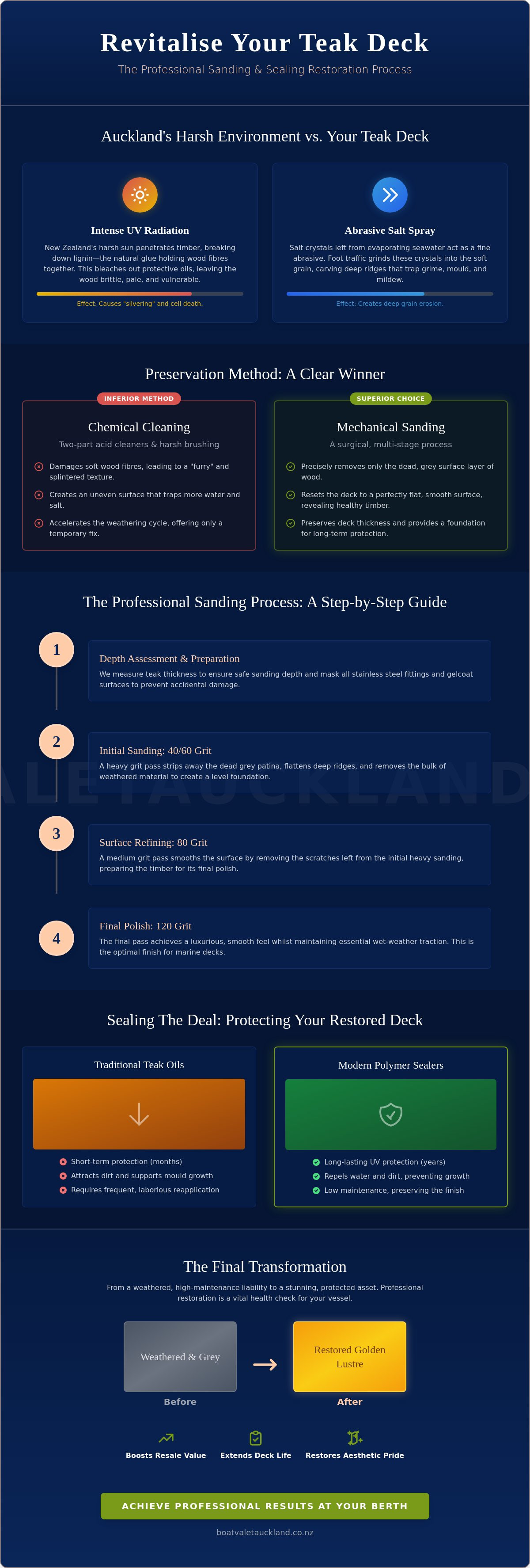
New Zealand’s UV index is significantly higher than in many other parts of the world. These harsh rays penetrate the timber and break down lignin, the natural organic polymer that binds wood fibres together. When you examine the properties of teak wood, you'll find it relies on its high oil content for protection. UV radiation effectively "bleaches" these oils out, leaving the wood brittle and pale.
Salt spray adds a mechanical element to this destruction. As seawater evaporates on the deck, it leaves behind microscopic salt crystals. These crystals act as a fine abrasive. Every time someone walks across the deck, these crystals grind into the softwood grain. In Auckland’s humid conditions, the resulting deep ridges become breeding grounds for mould and mildew. These fungi take root deep within the timber where standard washes can't reach them, leading to dark spots that ruin the wood's appearance.
When Cleaning Isn’t Enough
There comes a point where chemical brighteners and stiff brushes do more harm than good. If your deck has developed a "furry" or splintered texture, the softwood has been scrubbed away, leaving only the hard ridges behind. This uneven surface traps standing water and salt, which creates a cycle of rapid weathering that no amount of soap can fix.
At this stage, professional intervention is the only way to save the wood. A strategic sand-out resets the surface by removing the dead, ridged fibres. This reveals the healthy, golden timber underneath and prepares it for a high-grade sealer. It's a surgical approach to teak deck sanding and sealing that preserves the thickness of your deck whilst restoring the aesthetic pride of your vessel. Don't wait until the grain is too deep to recover; a timely restoration saves you from a full deck replacement down the line.
The Professional Teak Deck Sanding Process: A Step-by-Step Case Study
Restoration isn't just about appearance; it's about structural survival. Our case study begins with a vessel that had lost its lustre to the Hauraki Gulf's aggressive elements. Professional teak deck sanding and sealing is a multi-stage operation that requires a steady hand and a deep understanding of timber behaviour. We don't just start the machines and hope for the best. Every millimetre of wood removed must be calculated to ensure the deck remains functional for years to come.
Depth Assessment and Preparation
We start with a critical depth-check. We look for the thickness of the teak remaining above the screw heads and evaluate the integrity of the caulk adhesion. If the wood is too thin, aggressive sanding could expose the fastenings, which leads to water ingress and rot. Once we confirm the wood is healthy enough for restoration, we mask everything. Stainless steel fittings and gelcoat surfaces are covered with high-quality tape to prevent accidental scoring. The initial levelling pass uses a heavy grit to strip away the dead grey patina and flatten the ridges that trap salt and dirt.
Refining the Surface and Seam Detail
We then move through a strategic grit progression to achieve a professional finish. We typically start with 40 or 60 grit for the heavy lifting, removing the bulk of the weathered material. This is followed by an 80-grit pass to remove the scratches left by the first stage. We finish the teak deck sanding and sealing process with a 120-grit polish. Using 120-grit is the optimal choice for marine decks because it provides a smooth, luxurious feel whilst maintaining essential wet-weather traction for everyone on board.
During the process, we often find "proud" caulk seams. These are the ridges of rubber that stand higher than the wood as the timber wears down over time. We carefully trim these flush with a sharp chisel or specialized blade. This creates a seamless, flat surface that won't trip up your guests. After the final sand, we perform a thorough dusting and de-waxing. The wood must be perfectly clean and "thirsty" to accept the protective sealer. Following established wood preservation techniques ensures the new surface is ready for long-term protection. If your deck is showing signs of wear, our expert teak restoration team can help you determine the best path forward for your vessel.
Sanding vs. Chemical Stripping: Which Preservation Method Wins?
Many boat owners view chemical stripping as the gentle alternative to mechanical sanding. It feels less invasive to apply a liquid than a power tool. However, this is a common misconception that can lead to premature deck failure. When we look at long-term teak deck sanding and sealing, professional sanding is almost always the kinder option for the wood's structural integrity.
The Truth About Acid Cleaners
Two-part acid cleaners work by chemically burning away the top layer of wood. The first part is usually a strong acid that dissolves dirt and grey oxidation, but it also aggressively eats into the softwood pulp. The second part neutralises the acid but cannot replace the lost fibres. This leaves behind deep, jagged valleys that trap more salt and grime than before. You end up in a cycle of brightening that actually erodes the deck faster than any sander ever would.
There's also the environmental factor to consider. Auckland's marinas are sensitive ecosystems. The runoff from harsh two-part chemicals can be damaging to local marine life. If you want to keep your vessel looking sharp without the chemical assault, you should learn how to clean a teak deck on a boat using pH-neutral methods for your monthly maintenance. It's a safer way to manage the wood between professional restorations.
Longevity Calculations
The biggest fear owners have is that sanding removes too much wood. In reality, a professional sand-out removes a controlled, uniform layer to reset the surface. Acid cleaners remove wood unevenly. They often leave the hard grain standing whilst hollowing out the soft grain. This uneven wear makes the deck feel rough and look aged. A deck that is chemically bleached every season will often reach the end of its life years sooner than one maintained with a strategic teak deck sanding and sealing schedule.
How do you know if your deck is ready for a sand? Check these points before you begin:
Screw Depth: Use a small probe to check how much wood sits above the fastening heads.
Caulk Integrity: Ensure the caulk isn't pulling away from the wood, which suggests the groove is getting too shallow.
Grain Height: If the ridges are more than 1mm deep, cleaning won't help; you need a level sand.
Splintering: If the wood feels furry or splinters easily, the surface cells are dead and need removal.
Typically, a high-quality teak deck can handle a full professional sand every five to seven years, provided the daily maintenance is handled correctly. It's about preserving the meat of the timber whilst keeping the surface functional and beautiful. Don't let aggressive chemicals hollow out your investment when a precision sand can restore it properly.
Sealing the Deal: Protecting Your Restored Deck in 2026
Once the raw wood is revealed through precision sanding, it's at its most vulnerable state. The timber is clean, porous, and completely unprotected from the elements. Teak deck sanding and sealing is a two-part victory; the sand reveals the beauty, but the seal preserves the investment. Without a high-grade barrier, the Hauraki Gulf's salt and intense sun will reclaim the surface and begin the silvering process within weeks. You must lock in that golden colour whilst the wood is perfectly prepped.
Oil vs. Sealer: The NZ Verdict
Traditional teak oils were once the maritime standard, but they often fail in Auckland’s high-humidity environment. Oils stay "active" within the grain, which unfortunately attracts airborne soot, dirt, and dust. This mixture eventually turns the deck black and greasy, requiring aggressive cleaning that wears the wood down. We favour modern polymer sealers for local vessels. These products bond to the wood fibres to create a breathable, water-repellent shield that doesn't feel sticky.
Clear or lightly tinted sealers maintain the "just-sanded" aesthetic without the maintenance headache of oil. They provide superior UV blocking, which is essential for New Zealand's thin ozone layer. By preventing water from soaking deep into the grain, these sealers stop the internal dampness that leads to softwood rot and mould growth. It's a proactive approach to vessel care that keeps the timber stable and beautiful through every season.
Application Techniques for a Flawless Finish
Timing the application is critical for a professional result. We only begin the sealing process when the timber is bone-dry and the ambient temperature is stable. We typically use a "wet-on-wet" technique for the initial coats. This ensures the sealer penetrates deep into the thirsty wood cells rather than just sitting on the surface. Professional application avoids the common "lap marks" and uneven patches that occur when the product is applied too slowly or in direct, mid-day sun.
The first seal after teak deck sanding and sealing is the most important treatment your deck will ever receive. It sets the foundation for all future maintenance. A well-executed seal reduces the frequency of deep cleans and extends the time between required sandings by years. It simplifies your grooming routine, as salt and grime will sit on top of the sealer rather than grinding into the wood grain. Ready to bring your deck back to life? Book your professional teak restoration today and protect your vessel for the seasons ahead.
Mobile Teak Restoration: Professional Results at Your Berth
One of the biggest hurdles for vessel owners is the logistics of maintenance. Traditional boatyards often require you to move your vessel, which takes time and coordination. Our mobile service eliminates that stress. We bring the full suite of professional tools directly to your berth at Westhaven, the Viaduct, or Orakei Marina. This means your teak deck sanding and sealing can be completed whilst your boat stays in its home slip. It's a responsive, efficient model that respects your schedule and keeps your vessel accessible.
Steve Kellie leads every project personally. With over 25 years of Auckland maritime experience, he understands the specific needs of local vessels and the high standards expected in our marinas. You aren't dealing with a faceless corporation; you're working with a specialist who is personally accountable for the final result. We use specialised equipment designed for on-water dust containment. This ensures that the fine teak dust from the sanding process doesn't end up on your neighbour's flybridge or in the harbour water. Keeping the marina community happy is a core part of how we operate.
The Boat Valet Auckland Advantage
Choosing an owner-operator means the person who quotes the job is the one doing the work. This level of precision is rare in the industry. We often integrate our teak work with other marine detailing services NZ boat owners rely on to keep their assets in top condition. For example, many clients choose to combine their deck restoration with a professional boat cut and polish Auckland service. This holistic approach ensures the entire exterior is protected and gleaming, not just the timber. It's about delivering a complete aesthetic transformation that lasts.
Ready for the Season
Timing is everything in maritime maintenance. We encourage owners to book their teak deck sanding and sealing during the off-season. This avoids the summer rush and ensures your deck is ready for the first warm weekend of the year. If you're planning to list your vessel, a restored deck is a powerful selling point. It provides immediate visual confirmation to buyers that the boat has been meticulously maintained. A smooth, golden deck suggests a healthy boat. Don't let a grey, ridged deck hold back your vessel's value or your pride of ownership. Contact Steve today for a teak restoration quote and let's get your boat looking its best for the season ahead.
Restore Your Vessel's Pride This Season
Auckland's intense UV levels and salt spray can dismantle a teak deck quickly, but a weathered surface doesn't have to mean a full replacement. We've seen how mechanical sanding is a surgical alternative to aggressive acid cleaners, preserving the timber's structural integrity whilst revealing its original golden lustre. By choosing a high-grade polymer sealer instead of traditional oils, you lock in that protection and simplify your future maintenance routine.
Investing in professional teak deck sanding and sealing is the most effective way to extend your deck's life by years and protect your vessel's resale value. Since 1998, I've provided a fully mobile service across all Auckland marinas, bringing specialised expertise in both traditional and modern sealing techniques directly to your berth. You don't need to worry about the logistics of moving your boat; I'll handle the restoration right where you're moored.
Ready to see your deck transformed? Get a Professional Teak Restoration Quote from Steve today. Let's get your vessel ready for another spectacular season on the Hauraki Gulf.
Frequently Asked Questions
How much thickness is lost during a teak deck sanding?
Professional restoration typically removes between 0.5mm and 1.5mm of timber. The exact amount depends on the depth of the surface ridges and the extent of the weathering. We always aim to remove the minimum amount of wood necessary to reach healthy, golden fibres whilst ensuring the deck remains structurally sound for years to come.
How long does a professional teak deck seal last in Auckland?
A high-quality polymer seal generally lasts between 6 and 12 months in the Auckland climate. Longevity depends on your vessel's exposure to the Hauraki Gulf's intense UV rays and your cleaning frequency. Using pH-neutral soaps for your regular washes will help maintain the sealer's integrity and extend the time between professional treatments.
Will sanding my teak deck make it slippery when wet?
No, provided the wood is finished with the correct grit progression. We finish our sanding at 120-grit, which creates a smooth, luxurious feel underfoot whilst retaining the natural non-slip properties of the timber. Sanding actually improves safety by removing protruding caulk seams and uneven ridges that can cause trips or snags during heavy weather.
Can I sand my teak deck myself with a rental sander?
It's a risky move that often leads to expensive mistakes. Rental sanders usually lack the precision and industrial dust extraction required for marine timber. Without the right technique, it's easy to create deep gouges, over-sand thin areas, or heat up the caulk until it smears into the grain. Professional equipment ensures a perfectly level finish across the entire deck.
Is it better to oil or seal a teak deck after sanding?
Modern polymer sealers are the superior choice for Auckland’s high-humidity environment. Traditional oils stay active in the wood and tend to attract airborne soot and dirt, which eventually turns the deck black. Sealers bond to the fibres to create a breathable, water-repellent barrier that preserves the "just-sanded" look without the greasy residue or rapid darkening.
How do I know if my teak deck is too thin to be sanded?
Check the depth of the timber above your screw heads or fastenings. If the screw heads are visible or the caulk grooves have become very shallow, the wood may not have enough "meat" left for a full restoration. We perform a detailed depth-check during our initial assessment to ensure teak deck sanding and sealing is a safe and viable option for your vessel.
What happens if I don’t seal the teak after sanding?
The raw, unprotected wood will begin to silver and oxidise almost immediately when exposed to salt and sun. Without a protective barrier, the softwood pulp erodes quickly, leading to the return of deep ridges and trapped grime. Sealing is the essential final step in teak deck sanding and sealing that locks in the colour and prevents the wood from drying out.
How long does the teak restoration process typically take?
Most projects are completed within two to five working days. This timeframe allows for the initial preparation, multiple sanding stages, caulk trimming, and the application of several coats of sealer. We carefully monitor Auckland weather windows to ensure the timber is bone-dry before any product is applied, which is critical for a long-lasting bond and a professional finish.
Comments