
Boat Hull Polishing Auckland: Restore Your Hull with the Right Approach

Could a dull hull need a careful polish rather than a more aggressive cut? When it comes to boat hull polishing Auckland boat owners should choose an approach guided by the surface’s condition. Oxidation, fading and a powdery finish can point to polishing, while damage may need separate attention. A proper assessment helps avoid unnecessary work and sets realistic expectations for the result.
Boat Valet Auckland provides mobile Cut & Polishing for gelcoat and painted surfaces across Greater Auckland. Founded by Steve Kellie in 1998, the business brings more than 27 years of polishing experience. A free, no-obligation consultation lets you discuss your boat’s finish, location and access arrangements. At Hobsonville Marina, Boat Valet Auckland contributes 10% towards haul-out fees.
In this guide, you’ll learn how to recognise when your hull may benefit from polishing, how the work differs for gelcoat and painted surfaces, and what information helps plan the service. We’ll also cover how to arrange boat care at a marina, hard-stand or private property, so you can move forward with clear expectations.
Table of Contents
Boat hull polishing in Auckland: what a dull or chalky finish can tell you
Hull polishing is a surface-focused Cut & Polishing service for gelcoat or painted surfaces. It aims to improve the finish by addressing dullness and oxidation, rather than simply washing away dirt. Faded colour, reduced gloss or powdery residue on a clean cloth can be reasons to have the surface assessed. These signs don’t, on their own, show how much correction is appropriate.
Gelcoat forms a protective outer surface, but exposure to sunlight and weathering can gradually break down its resin-rich layer. This process, called oxidation, can leave the finish looking flat or chalky. For background on marine gelcoat properties, gelcoat is typically around 0.5 to 0.8 mm thick. That’s one reason to assess the surface before polishing: more cutting won’t automatically produce a better result.
What can make a boat hull look faded or chalky?
Oxidation can leave a surface looking tired, but it doesn’t necessarily mean the hull is damaged. A dull, evenly faded area may respond to suitable Cut & Polishing, but polishing won’t fix every mark. Chips, cracks, deep scratches or other localised damage may need separate Gel Coat Repairs. Age and surface type also affect what’s appropriate, so appearance alone can’t determine the work.
Is hull polishing the same as antifouling?
No. Cut & Polishing addresses the appearance and condition of gelcoat or painted surfaces. Antifouling is a separate service for protecting the underwater hull from marine growth. One doesn’t replace the other. If you’re planning protection below the waterline, our Auckland antifouling hull protection guide explains that work in more detail.
For boat hull polishing Auckland owners should start with the surface, not a preset level of correction. Identifying whether the finish is oxidised, painted or damaged helps set a suitable scope and avoid unnecessary work.
How Auckland boat hull polishing is planned around your surface
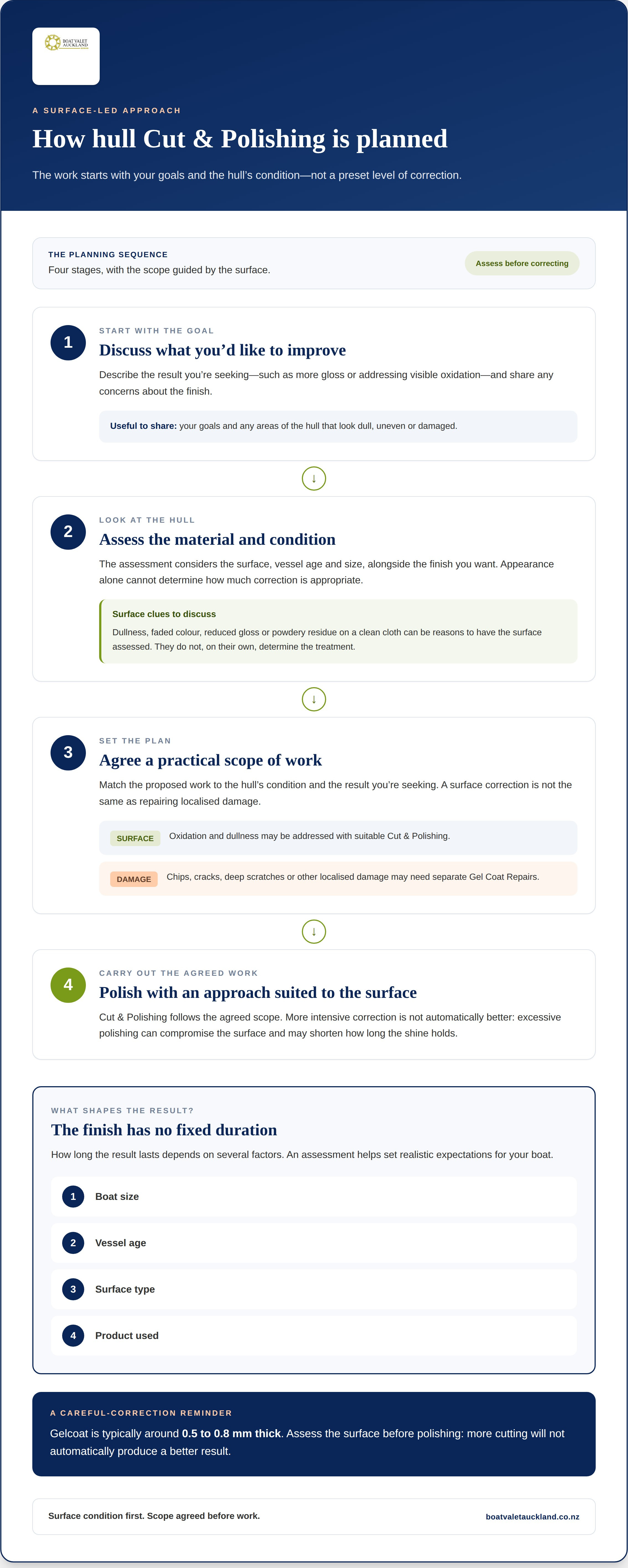
A sound result starts with your boat’s condition, not a standard polishing routine. For boat hull polishing, Auckland owners can expect a clear sequence: discuss the finish they want, assess the surface, agree the scope, then complete the Cut & Polishing. Careful evaluation helps match the work to the hull, rather than applying more correction than it needs.
Discuss your goals. Explain what you’d like to improve, such as gloss or visible oxidation, and share any concerns about the finish.
Assess the hull. Consider the surface condition, material and vessel age, as well as the size of the boat.
Agree the scope. Set a practical plan based on the assessment and the result you’re seeking.
Complete Cut & Polishing. The work follows the agreed scope, with an approach suited to the surface.
What does the hull assessment consider?
Visible oxidation is only one part of the picture. The assessment also considers whether the surface is gelcoat or paint, the vessel’s age and your desired finish. If the hull has chips, cracks or other damage, polishing alone may not address it. The discussion can distinguish surface correction from separate Gel Coat Repairs, so the agreed scope reflects what the hull needs.
How does the finish affect expected durability?
There’s no fixed duration for Cut & Polishing results. Boat size, age, surface type and the product used all affect how long the finish lasts. Excessive polishing can compromise the surface and may shorten the time the shine holds, so more intensive work isn’t automatically better. Hull maintenance also sits alongside wider biofouling considerations described in the IMO biofouling and hull maintenance guidelines.
The hull’s age, size, surface type and chosen product all influence how long the finish may last, so an assessment helps set realistic expectations.
Share your goals and the hull’s condition to help plan the right scope. You can discuss your boat’s Cut & Polishing with the team before work is agreed.
DIY or professional boat hull polishing in Auckland: how to choose the scope
A routine wash can remove dirt and salt from a hull, but it won’t necessarily restore gloss or address oxidation. Correction work is different. It requires a clear view of the surface and a measured approach, especially if you’re unsure whether the hull is gelcoat or paint. Choosing the right scope matters: unnecessary or excessive polishing can wear the surface and may reduce how long the shine lasts.
For boat hull polishing, Auckland owners should weigh the hull’s condition, size, age and surface type rather than decide by appearance alone. If the finish is simply dirty, routine cleaning may be enough. If dullness or oxidation remains, those signs are reasons to seek an assessment, not a guarantee of a particular result. Avoid treating more intensive correction as the automatic next step.
When is professional Cut & Polishing worth considering?
Consider a professional assessment if the finish stays dull after cleaning, looks uneven or shows visible oxidation. These symptoms help guide the discussion, but don’t establish the right treatment on their own. Steve Kellie has over 27 years of polishing experience, and the team has worked on thousands of boats. That experience informs a surface-led approach, with the scope matched to the hull rather than assumed in advance.
What should you expect from a tailored quote?
A quote should reflect the boat and the work required, not a one-size-fits-all polishing package. Boat size, age, surface type and condition all affect the scope and variable pricing. A free, no-obligation consultation is the starting point; a quote follows assessment, so you can understand what’s proposed before deciding. It’s also an opportunity to explain your priorities and discuss any concerns about the finish.
If you’re weighing up routine care against correction work, arrange a free hull polishing consultation to discuss your boat’s surface and a suitable scope.
Arrange mobile boat hull polishing across Auckland
Boat Valet Auckland brings mobile Cut & Polishing to marinas and private properties across Greater Auckland. That can simplify planning when your boat is based at Hobsonville Marina, Westhaven, Half Moon Bay or Gulf Harbour. Share where the vessel is kept so the work can be discussed in the context of its location and condition.
What information helps plan an Auckland hull-polishing visit?
For boat hull polishing, Auckland owners can make the first discussion more useful by sharing a few practical details:
The vessel’s location and where it can be accessed.
Whether the hull surface is gelcoat or painted, if you know.
What you’ve noticed, such as fading, dullness or visible oxidation.
The finish you’d like to achieve and any particular concerns.
This gives Steve a starting point for discussing the likely scope and a tailored quote. The quote follows a free, no-obligation consultation, with pricing varying according to the boat and its surface.
How does mobile boat grooming fit around marina or home access?
With a mobile service, your boat can be cared for at a Greater Auckland marina or private property. Share its location and any relevant access details early, so practical arrangements can be included in the planning conversation. The mobile boat grooming Auckland guide explains more about arranging care at different locations.
At Hobsonville Marina, Boat Valet Auckland contributes 10% towards haul-out fees. This contribution applies at Hobsonville Marina only.
Ready to plan the next step? Discuss your boat, its location and the finish you want with Steve, and arrange a free, no-obligation consultation.
Give your hull a considered next step
A polished finish starts with choosing work that suits the boat, not chasing a perfect appearance at any cost. If you’re unsure whether the surface needs attention, a discussion about your priorities can help turn uncertainty into a practical plan. The scope should be guided by the hull’s condition.
For boat hull polishing, Auckland owners can take the next step by arranging a consultation with Steve. Describe what you’d like to improve and raise any questions about the surface. You can discuss a suitable approach and receive a quote based on your boat and its condition, without committing to a preset level of polishing.
Arrange a free, no-obligation consultation with Steve to discuss your hull’s condition and plan a suitable approach.
Frequently Asked Questions
Does boat hull polishing remove oxidation?
Boat hull polishing can reduce visible oxidation and improve the finish, but the result depends on the surface’s condition and material. If a hull still looks dull after washing, that can indicate the issue is more than surface dirt. Deep marks or damage need separate consideration, so an assessment helps set realistic expectations before correction work begins.
Is boat hull polishing the same as antifouling?
No. Polishing works on the finish of gelcoat or painted surfaces, while antifouling is a separate treatment for the underwater hull. They serve different purposes, so one isn’t a substitute for the other. If your boat needs both appearance care and underwater protection, discuss each requirement separately when planning its maintenance.
Can a painted boat hull be polished?
Yes, painted surfaces can be included in Cut & Polishing. The approach needs to suit the coating, so don’t assume a method that seems appropriate for gelcoat will also suit paint. If you’re unsure what finish your boat has, share its details during an assessment. This helps guide the scope and avoid treating a painted surface as though it were gelcoat.
How long does a boat cut and polish last?
There’s no fixed duration for a boat Cut & Polish. Durability varies with factors including the boat’s size, age, surface type and the product used. A quote can describe the proposed work, but it isn’t a promise that the finish will last for a set period. Discuss your expectations alongside the hull’s condition to keep the plan realistic.
Can hull polishing repair chips or damaged gelcoat?
No. Polishing improves the surface finish, but it doesn’t replace missing gelcoat or repair chips and cracks. Those issues need separate attention, such as Gel Coat Repairs, before the surrounding finish is considered for polishing. Point out any damaged areas during an assessment. This helps distinguish cosmetic correction from repair work and clarify what the hull needs.
Comments